Custom Software vs Off-the-Shelf
Off-the-shelf software looks cheaper upfront, but hidden costs add up fast. Here's how to work out which option actually saves your business money.
Which One Actually Saves You Money?
"Just use an off-the-shelf tool, it's cheaper" is the most common piece of advice founders get and it's only half true.
Off-the-shelf software almost always wins on day one. It wins on month three, too, sometimes. But past a certain point of growth, the monthly subscription fees, the workarounds, and the things your team quietly stops doing because "the software doesn't support that" start costing more than a custom build ever would have.
This isn't an argument for building everything custom. It's a framework for knowing which one actually saves you money for your specific business, at your specific stage.
The upfront cost comparison is misleading
Off-the-shelf software has a sticker price: $49/month, $200/month, whatever the tier is. Custom software has a project quote: $15,000, $40,000, $100,000+. Compared side by side, off-the-shelf wins every time.
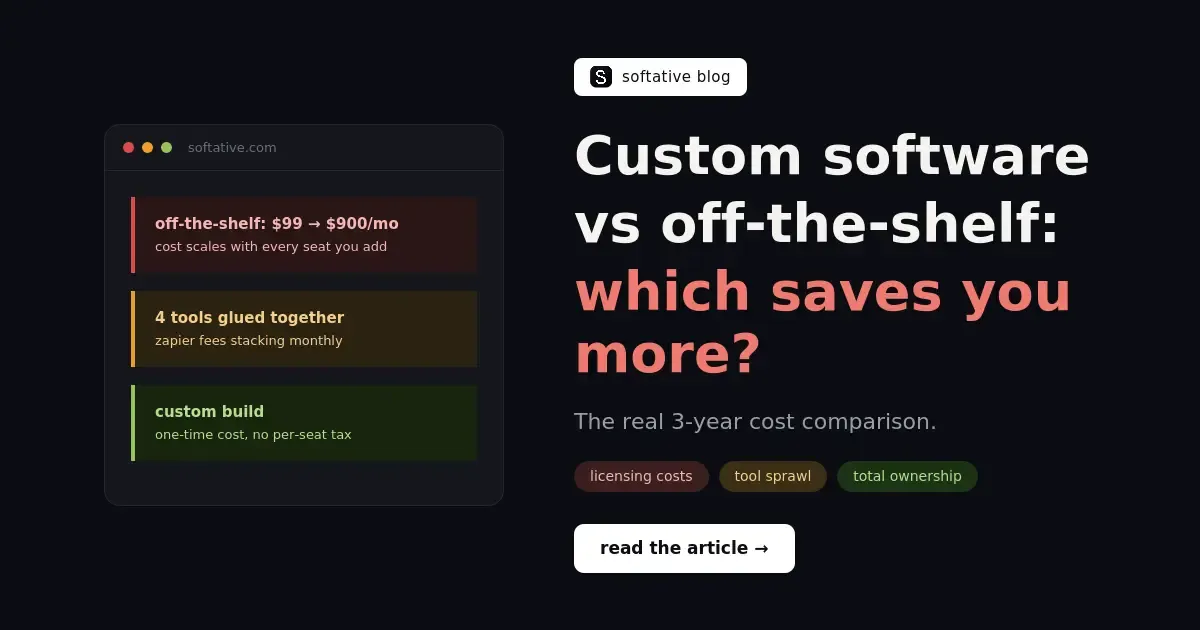
But that comparison only captures the purchase cost, not the total cost of ownership. Off-the-shelf pricing usually scales with usage more users, more contacts, more transactions, more seats. A tool that costs $99/month at 10 users can cost $900/month at 100 users, for the exact same functionality. Custom software has no per-seat tax. You pay once to build it, and scaling users costs you infrastructure pennies, not license fees.
Where off-the-shelf actually wins
Off-the-shelf is the right call when:
- Your workflow is genuinely standard invoicing, email marketing, basic CRM, project tracking for a small team
- You need something running this week, not this quarter
- You're still validating whether the process is even worth automating
- The tool's roadmap already covers 90%+ of what you need
If your business runs on processes that thousands of other businesses also run, someone has almost certainly already built and refined software for it. Don't reinvent invoicing.
Where custom software starts saving money
Custom software pulls ahead once any of these becomes true:
You're paying for features you don't use, to get the one you do. Many SaaS tools are priced by tier, and the tier with the feature you actually need also bundles ten you don't. You're subsidizing someone else's roadmap.
You're stitching together 4-5 tools with Zapier or Make to do what should be one workflow. Each connection is a monthly fee, a point of failure, and someone's job to maintain. At scale, that "glue" often costs more per month than a custom system would have cost to build outright.
Your team has built manual workarounds around the software's limits. If someone is exporting a CSV every Friday to do something the tool can't, that's not a minor inconvenience it's a recurring labor cost hiding in plain sight. Multiply that person's hourly rate by the hours spent working around software limitations, every month, and compare it to a one-time build cost.
Your data is your product or your edge. If your competitive advantage lives in how you handle customer data, pricing logic, or internal operations, running it inside someone else's platform means you're renting your own advantage and you're one pricing change or feature deprecation away from disruption.
A simple way to run the numbers
Before deciding, add these up over a 3-year horizon:
- Off-the-shelf cost: current monthly fee × expected seat/usage growth × 36 months, plus the cost of any integration tools (Zapier, Make) you'd need to bridge gaps
- Workaround cost: hours per month your team spends on manual workarounds × their hourly cost × 36 months
- Custom software cost: one-time build cost + modest ongoing maintenance (typically 15-20% of build cost per year)
For a lot of growing businesses, line 1 + line 2 quietly overtakes line 3 well before month 36 often faster than expected once usage-based pricing kicks in.
The middle ground most people miss
It's rarely all-or-nothing. Plenty of businesses run off-the-shelf tools for the standard stuff (accounting, email) and build custom software only for the one workflow that's actually unique to how they operate the thing no template was ever designed for. That's usually where the real ROI is: not replacing every tool, but replacing the one that's costing you the most in fees, workarounds, or lost flexibility.
The real question to ask
Don't ask "what's cheaper to buy." Ask "what's cheaper to run for the next three years, at the size we expect to be." Off-the-shelf software is a rental. Custom software is an asset. Which one makes sense depends entirely on how long you'll be paying rent, and how much the landlord can raise it on you.
If you're not sure which side of that line your business is on, that's usually the first thing worth mapping out before committing budget either way.
Contact Us if you are also looking for custom software.
Written by Yash Patel