How Much Does a Business Website Cost in 2026? (Complete Pricing Guide)
If you've started asking vendors for quotes, you've probably noticed the answers don't agree. One agency says $2,000. Another says $35,000. A freelancer on Fiverr says $500. So who's lying?
Nobody they're just quoting different things. A website isn't one product, it's a spectrum, and where you land on it depends on who builds it, how complex it is, and what it needs to do for your business. This guide breaks down real 2026 numbers so you know what you're actually paying for and what you're risking if you go too cheap.
The Quick Answer
Build TypeUpfront CostBest For
Startups, e-commerce, platforms with logic and integrations
Most small businesses with a genuine growth goal land in the $4,000–$15,000 range for a professionally built, custom site. That's the number to anchor on if someone quotes you wildly outside it high or low.
Why the Range Is So Wide
A website's price isn't really about pages it's about decisions. Every one of these adds cost, but also adds value if your site needs it:
- Number and type of pages: a 5-page brochure site vs. a 20+ page resource-heavy site
- Custom design vs. template: fully custom UX research and visual design typically adds 20–40 hours of work
- Content production: professional copywriting and photography rather than placeholder text
- Functionality: booking systems, e-commerce, portals, calculators, or API integrations can each add thousands
- Technical setup: analytics, CRM integration, SEO foundations, and search monitoring are standard above $10,000 but rarely included below $5,000
This is why two businesses that look similar on the surface can get quotes that differ by 5x. The quote isn't random it's a reflection of what's actually being built.
Breaking Down Each Option
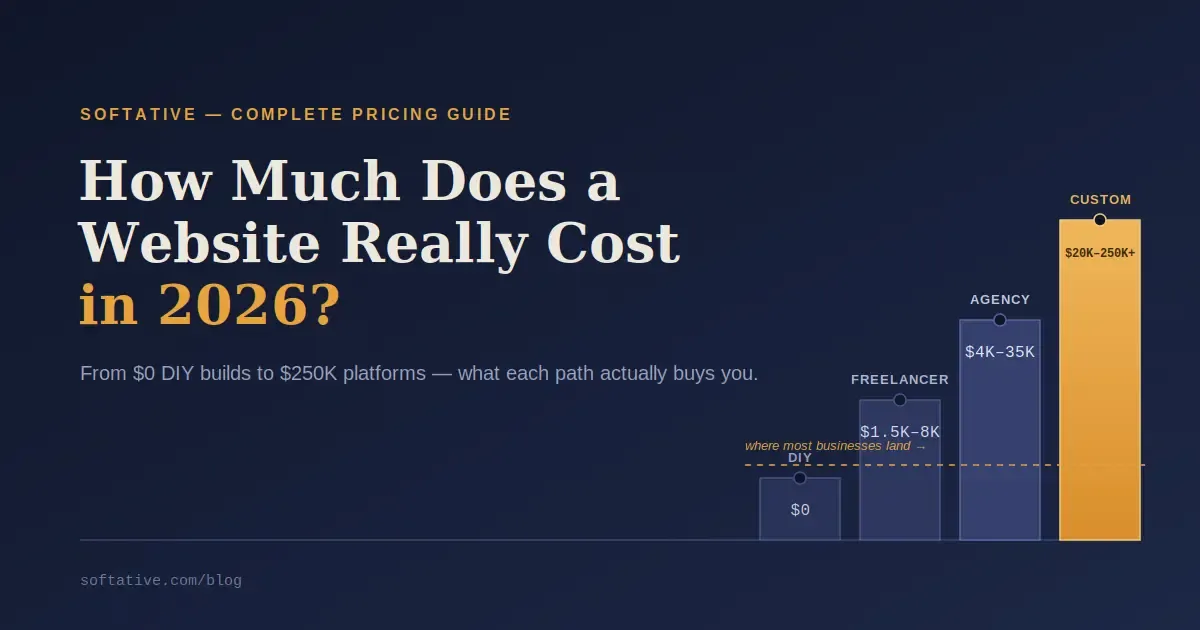
DIY Builders ($0–$1,600 build, $200–$600/year ongoing)
Tools like Wix, Squarespace, and WordPress.com get you online fast with no technical skill required. They're a reasonable starting point for very early-stage businesses, but most owners eventually hit a wall: limited customization, restrictive SEO, and a site that looks and performs like a template, because it is one. Migrating off these platforms later is often a full rebuild, not a transfer.
Freelancers ($1,500–$8,000 one-time)
A good middle ground if your needs are straightforward. You get a custom design without agency overhead, typically delivered in 4–6 weeks for a basic brochure site. The trade-off is support: once the project ends, ongoing updates usually require a separate arrangement, and consistency can vary if you ever need to bring in someone new.
Custom Agency Builds ($4,000–$35,000+)
This is where strategy, conversion-focused design, and long-term scalability come into the picture. Agencies typically start small business projects in the $4,000–$8,000 range and scale based on complexity e-commerce, integrations, and custom functionality push that higher. The upfront cost is bigger, but so is the difference in what you're actually getting: a site engineered to convert visitors into customers, not just exist.
Custom Web Applications & MVPs ($20,000–$100,000+)
If your "website" is really a platform user accounts, payments, dashboards, multi-step logic you're no longer in website territory, you're in software territory. Focused MVPs typically start around $20,000–$50,000, with multi-tenant production systems involving payments, roles, and analytics often exceeding $100,000.
The Cost Nobody Budgets For: Year Two and Three
This is the part most pricing guides skip, and it's where a lot of business owners get burned. A website's three-year cost is usually 2x to 3.4x its initial build price once you factor in hosting, maintenance, content updates, and the inevitable iteration after launch. A $12,000 site with modest ongoing support typically runs $23,000–$42,000 over three years. A $28,000 site with proper maintenance can land between $65,000–$95,000 over the same period.
The takeaway: the cheapest quote up front is rarely the cheapest website over time. A template-based site that needs a full rebuild in year three because it can't scale isn't actually the budget option it's just a delayed, bigger bill.
A Useful Industry Benchmark
According to recent buyer surveys, the majority of small businesses now spend under $10,000 on their most recent website project, though that share has been shrinking as buyers increasingly demand custom design and conversion-focused features rather than generic templates. In other words: expectations are rising, and "cheap and generic" is becoming a harder sell to your own customers, not just a budget question.
How to Actually Budget for This
A reasonable rule of thumb: if your website is meant to generate leads or revenue (and for almost every business in 2026, it is), plan to spend 5–15% of your first-year revenue goal on your digital footprint covering the build, basic SEO, content, and the first year of hosting and maintenance.
Before requesting quotes, get clear on:
- What pages and functionality you actually need (not just "a website")
- Whether you need ongoing support, and how much
- What's included vs. billed separately (copywriting, photography, SEO, maintenance)
- Your realistic 3-year cost, not just the launch price
The Real Question Isn't "How Much" It's "How Much Is It Costing You Now?"
A slow, outdated, or poorly converting website has its own price tag it's just hidden in the customers who bounce before they call you. Before you fixate on the build cost, it's worth knowing what your current site might already be costing you in lost business.
If you want a clear, no-fluff quote based on what your business actually needs not a generic package Softative can walk you through it.
Written by Yash Patel