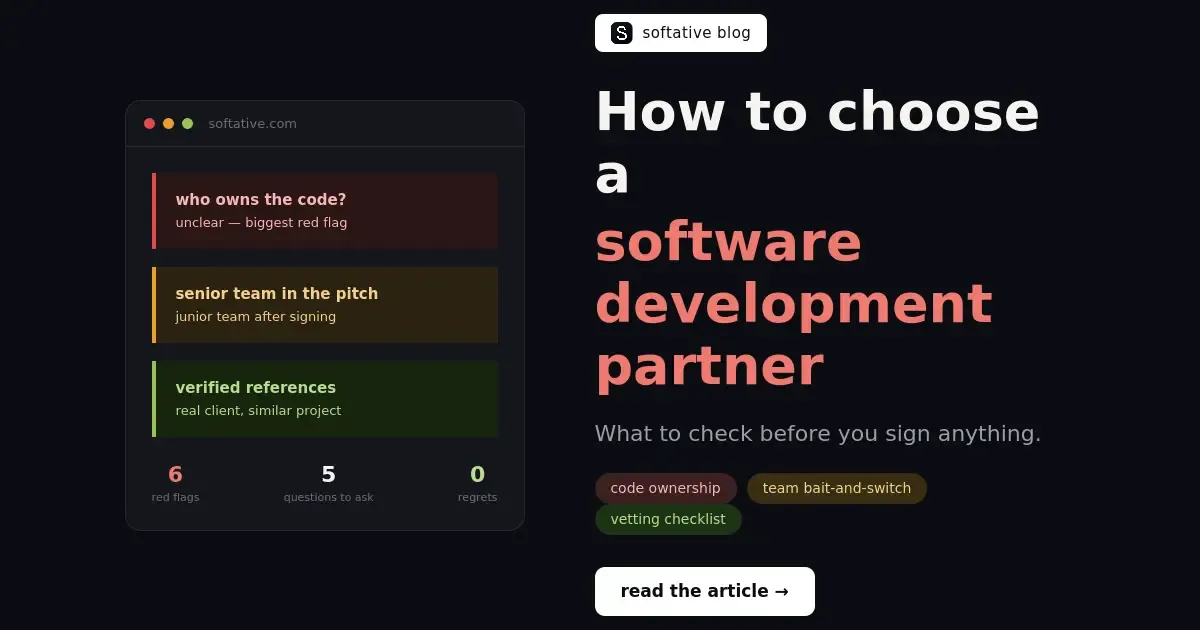
How to Choose a Software Development Partner or Agency
Choosing a software development agency is a high-stakes decision. Here's exactly what to check before you sign, so you don't end up rebuilding in a year.
How to Choose a Software Development Partner
Most bad agency experiences don't show up in the pitch meeting. They show up six months in, when the code is hard to change, the person who understood your project has left, and every small request suddenly needs a new quote.
Choosing a development partner is closer to hiring a co-founder for a piece of your business than buying a service. Here's what actually separates a good decision from an expensive mistake.
Start with proof, not promises
Anyone can say "we build custom software." Ask instead:
- Can I talk to a past client, not just see a logo on your site?
- Can you show me a project similar in size and complexity to mine not just your best-ever work?
- What happened on a project that didn't go to plan, and what did you do about it?
A partner who has a real, specific answer to that last question is more trustworthy than one who claims a perfect track record. Every agency has had a hard project. The ones worth hiring can tell you exactly what they learned from it.
Understand who actually does the work
Many agencies sell you a senior team in the pitch and hand you a junior team after signing. Before committing, ask directly:
- Who will be working on my project day-to-day, by name?
- Will that team change partway through, and if so, how do you handle handoff?
- Is any part of the work subcontracted or outsourced further, and to whom?
You're not being difficult by asking this you're finding out who you're actually trusting with your project.
Check how they handle ambiguity
Early-stage projects are rarely fully specified, and that's normal. What matters is how a partner handles the gaps:
- Do they ask sharp clarifying questions, or do they just quote whatever you wrote?
- Do they push back when a request doesn't make sense, or agree to everything?
- Do they talk about tradeoffs (cost vs speed vs flexibility) or only about what's technically possible?
A partner who never says "have you considered doing this differently" isn't being agreeable they're not thinking critically about your problem. That habit shows up later as scope creep and rebuilds.
Get clear on ownership, from day one
This is the single most overlooked item in vendor selection, and the one that causes the most pain later:
- Do you own the full source code, outright, when the project ends?
- Do you own the accounts hosting, domain, third-party services or does the agency?
- Can you take the code and hand it to another developer or team without the original agency's involvement?
If the answer to any of these is unclear or "it depends," get it in writing before you sign anything. Vendor lock-in is rarely intentional, but it's extremely common, and it's expensive to untangle later.
Match their process to your stage
A pre-launch startup validating an idea needs speed and flexibility. A scaling business automating core operations needs stability and rigor. The same agency isn't automatically right for both. Ask:
- What does your typical project timeline and check-in cadence look like?
- How do you handle changing requirements mid-project?
- What happens after launch is there a maintenance plan, or are we on our own?
If their process feels rigid for an early-stage idea, or too loose for a business-critical system, that's a mismatch worth noticing before you commit, not after.
Price is a signal, not just a number
The cheapest quote and the most expensive quote are both worth being suspicious of, for different reasons. A quote far below market usually means junior resourcing, corners cut on testing, or a scope that will "discover" extra costs later. A quote far above market isn't automatically better but ask what it includes that the others don't (architecture planning, QA, post-launch support) before assuming it's overpriced.
Compare quotes on what's actually included, not just the headline number.
Red flags worth walking away from
- Pressure to sign quickly, or discounts tied to an artificial deadline
- Vague answers about who owns the code and accounts
- No willingness to connect you with a past client
- A proposal with no discovery phase jumping straight to a fixed quote for a complex project is a guess, not an estimate
The bottom line
The right partner isn't the one with the flashiest portfolio or the lowest price. It's the one who asks good questions, is transparent about ownership and process, and has a track record you can actually verify. Spend the extra week vetting properly it's far cheaper than spending the extra six months fixing a project built by the wrong team.
Written by Yash Patel