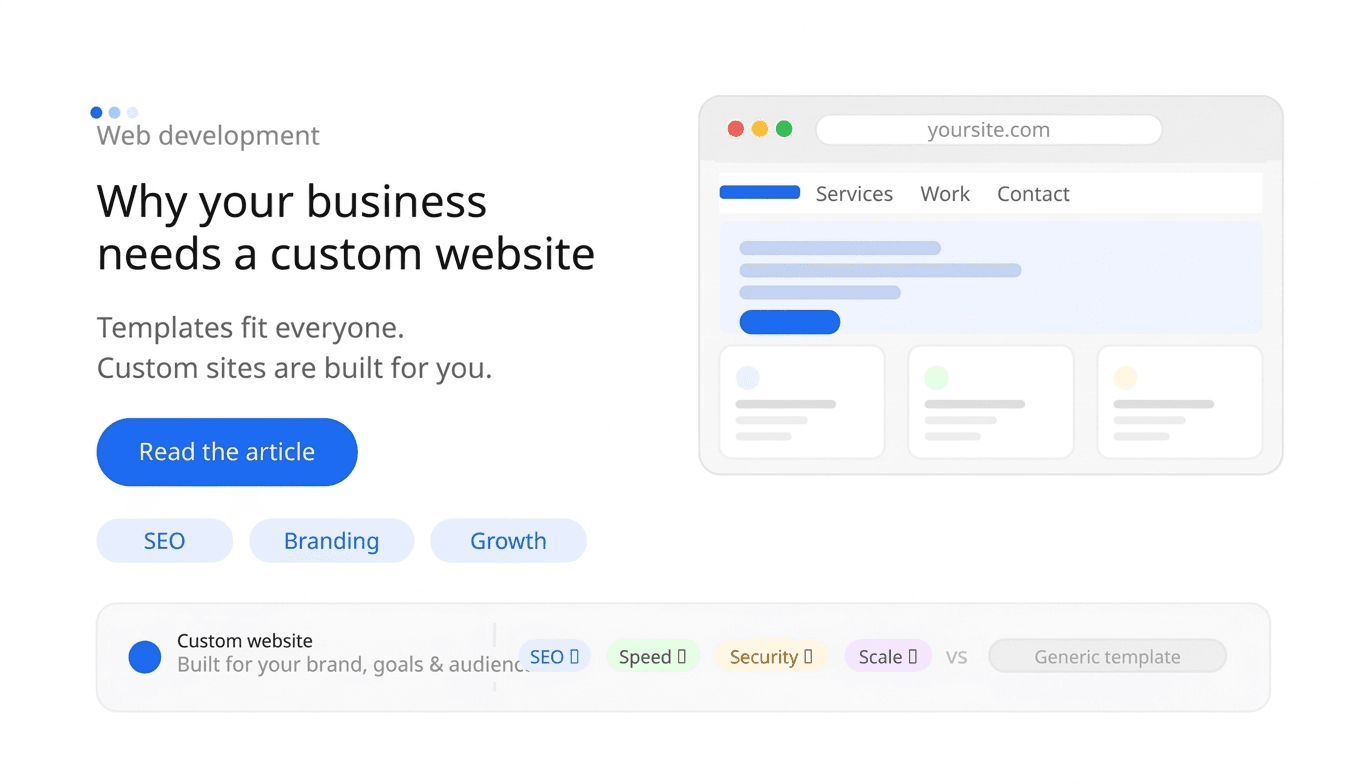
Why Your Business Needs a Custom Website
Still running on a template or no website at all? Here's why every serious business needs a custom website in 2025 - and what it's actually costing you not to have one.
Let's be honest when someone hears about your business for the first time, the very next thing they do is Google you.
Not call you. Not walk in. Google you.
And if what they find is a half-finished Wix page, a clunky template that loads slowly on mobile, or worse nothing at all that's the impression they carry forward. First impressions in 2026 are almost entirely digital, and a generic or absent online presence is silently costing businesses more than they realise.
This isn't about having "a website." It's about having the right website. One that's built around your business, your customers, and your goals. That's exactly why more and more businesses from local service providers to growing e-commerce brands are realising they need a custom website, not just any website.
A Template Website Is Built for Everyone. That Means It's Built for No One.
When you use a drag-and-drop builder or a pre-made theme, you're working within someone else's constraints. The layout, the navigation structure, the features all of it was designed to work generically for thousands of different businesses. And that's the problem.
Your business isn't generic. Your audience has specific habits. Your services require specific flows. Your brand has a specific voice.
A template forces you to adapt your business to the tool. A custom website does the opposite it's built around how your business actually works. That difference shows up everywhere: in how fast pages load, how easy it is for visitors to find what they need, and whether they stay or bounce within seconds.
Search Engines Reward Custom-Built Websites
If you're putting any effort into SEO or planning to you need a custom website as your foundation.
Here's why.
Template platforms come with bloated code, shared structures, and limited control over the technical elements that search engines care about most. Things like page speed, clean URL structures, schema markup, Core Web Vitals, and mobile-first indexing these aren't bonus features. Google uses them as ranking factors.
Custom-built websites are coded from the ground up with these in mind. Developers can optimize every page individually, keep the codebase lean, and structure content in a way that's genuinely easy for search engines to crawl and index. The result is better rankings, more organic traffic, and a site that doesn't fight you every time you try to make an SEO improvement.
If you're serious about showing up on Google, you need a custom website not a platform that ties your hands.
Your Brand Deserves More Than a Stock Template
Think about the brands you trust. The websites you remember. None of them look like a default theme with the logo swapped out.
Brand consistency builds trust. And trust is what converts visitors into customers. A custom website gives you complete control over every visual and interactive element the colours, typography, spacing, animations, and the overall feeling someone gets when they land on your page. It's the difference between a site that feels like you and one that feels like everyone else.
When a potential client lands on a well-designed, intentional website, they immediately sense that the business behind it is serious, professional, and worth their time. That subconscious signal matters more than most businesses give it credit for.
It Grows With You Not Against You
One of the biggest hidden costs of template-based websites is what happens when your business evolves.
You launch a new service. You want to add a client portal. You need to connect your CRM. You want to integrate a booking system, or a custom quote calculator, or a member login area. With most template platforms, these additions either aren't possible, require expensive workarounds, or involve stitching together plugins that conflict with each other.
A custom website is architected with growth in mind. Want to add a feature six months from now? It can be built in. Need to scale up as traffic increases? The infrastructure handles it. This kind of flexibility isn't a luxury it's a practical business requirement for any company that plans to grow.
Security Isn't Optional Anymore
Template websites and popular CMS themes are well-known targets for automated attacks precisely because the vulnerabilities are predictable and widely shared. When thousands of websites use the same plugin or theme, hackers only need to find one flaw and deploy it at scale.
Custom-built websites don't have that problem. The codebase is unique, the architecture is specific to your site, and security can be built in from the start rather than patched in afterward. For businesses handling customer data, online payments, or sensitive information, this isn't a minor consideration it's essential.
Real Businesses, Real Results
The businesses we've worked with that made the switch from templates to custom websites consistently report the same things: faster load times, more enquiries through their contact forms, better rankings on Google, and a website they're actually proud to share.
That last point matters more than people admit. When you're embarrassed to hand out your business card because you know your website doesn't reflect the quality of your work, something has to change.
If you've been putting off building something proper because it feels expensive or complicated that's exactly the kind of concern we help businesses work through. The right development partner makes the process straightforward, and the long-term return far outweighs the upfront investment.
So, Do You Need a Custom Website?
If your business is serious about growth, visibility, and making a strong impression yes, you need a custom website. Not eventually. Now.
A custom website isn't just a better-looking version of what you already have. It's a business asset that works for you around the clock, ranks better on search engines, scales alongside your growth, and represents your brand the way it deserves to be represented.
Ready to build something that actually works? Get in touch with our team and let's talk about what's possible.
Written by Yash Patel